4634 16 Ave NW, Calgary · Minutes from Market Mall
 3x XPEL Dealer of the Year
4634 16 Ave NW, Calgary · Minutes from Market Mall
3x XPEL Dealer of the Year

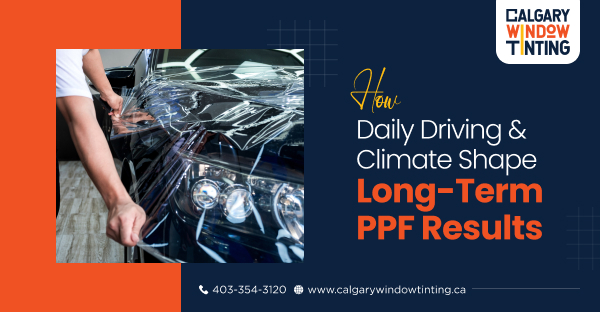
PPF for cars is often sold as a set-it-and-forget-it solution. That assumption rarely survives real-world usage. Long-term film performance depends on how the vehicle is driven, where it is exposed, and how consistently it is maintained. For drivers considering installations of PPF in Calgary, understanding these variables separates lasting protection from premature disappointment. Performance decay is gradual, measurable, and directly influenced by owner behaviour.
PPFs are made to stand strong for a long time, but there are some aspects that influence their performance. Because sometimes, the films lose their functionality due to some damage as well. Let’s get into the details.
Driving Patterns and Impact Frequency
Usage intensity defines the stress profile placed on car PPF installations. Daily highway driving exposes film surfaces to constant gravel impact, airborne debris, and aerodynamic abrasion. City-only vehicles experience less kinetic damage but face more chemical exposure from traffic pollution. Aggressive driving increases frontal impact zones. Over time, cumulative micro-damage challenges even premium films, while lower-grade PPF degrades rapidly under identical usage patterns.
Environmental Exposure and Climate Load
Environmental exposure shapes film longevity more than mileage alone. Vehicles parked outdoors face prolonged UV radiation, thermal cycling, and moisture accumulation. In Calgary’s scenarios, freeze-thaw cycles stress adhesive bonds and film elasticity. Road salt accelerates chemical fatigue. Garage-kept vehicles show slower degradation curves. Environmental load determines whether PPF clarity and adhesion remain stable or deteriorate prematurely.
Calgary’s dry weather also impacts PPF installation on cars. Click here to read the blog.
Wash Habits and Surface Interaction
Maintenance routines directly affect PPF surface integrity. Automated car washes introduce rotating brushes and abrasive contaminants. These accelerate topcoat wear and micro-marring. Hand washing with proper techniques preserves self-healing properties longer. Harsh detergents strip hydrophobic layers. Over time, neglected maintenance causes film to appear dull or stained. Performance loss often reflects wash habits rather than product failure.
Contamination Management and Decontamination Cycles
Industrial fallout, brake dust, and organic contaminants embed into film surfaces gradually. Without periodic decontamination, these particles compromise clarity and elasticity. PPF car wraps or single film installations benefit from scheduled iron removal and gentle clay treatments. Skipping these steps allows contaminants to bond permanently. Once embedded, surface correction options become limited, reducing both aesthetic and protective effectiveness.
Installation Quality and Tension Control
Even the best PPF performs poorly if installed incorrectly. Excessive stretch introduces internal stress points. Misaligned seams invite moisture intrusion. Over time, these flaws propagate into edge lift or adhesive breakdown. Professional installers of PPF in Calgary manage tension, overlap, and surface prep meticulously. Installation precision determines whether film performance degrades predictably or fails unpredictably.
Vehicle Storage and Idle Exposure
Storage conditions influence film ageing independent of driving. Vehicles stored outdoors accumulate UV damage even when stationary. Heat buildup accelerates polymer fatigue. Indoor storage moderates these effects. Long idle periods without cleaning allow contaminants to etch film surfaces. Storage strategy plays a measurable role in long-term PPF performance outcomes.
Maintenance Products and Aftercare Discipline
Using incompatible products shortens film lifespan. Petroleum-based dressings, abrasive polishes, and aggressive solvents degrade top layers. Approved PPF-safe sealants enhance hydrophobic behaviour and UV resistance. Consistent aftercare preserves elasticity and gloss. Neglecting aftercare shifts degradation curves forward, making replacement necessary sooner than expected.
PPF for cars performs as well as the conditions it operates within. Driving habits, environmental exposure, wash routines, and installation quality collectively determine longevity. In climates like Calgary, disciplined maintenance and realistic usage expectations protect performance over time.
PPF in Calgary or anywhere is not passive protection. It is a system that rewards informed ownership with sustained results. To get your car a proper PPF layer, visit Calgary Window Tinting or get in touch with us for more information.
 403-354-3120
  7 Days 7:00 AM - 9:00 PM